Search the Archives

Saturday, June 14, 2014

Caesar Alloquitur: Save Mosul; Save Iraq

The Case for War in Iraq to Crush the Islamic Militants

According to the Just War Doctrine of the Catholic Church

Pope Blessed Urban II preaches the First Crusade at the Council of Clermont.

Introduction

The recent events in Iraq in conjunction with our withdrawal of troops has been nothing short of disastrous for the people of Iraq. We far from achieved a victory over our foes in the Jihad movement, for a variety of reasons. We may be tempted to say, "it is not our problem." However, it is our problem. Seeing as how this editorial is for a Catholic lay movement, I can only speak for us. Not all Iraqis and Middle Easterners are Muslim - far from it. In fact, the Middle East holds Christian communities that not only predate Islam but can trace their birth to the Apostles.

Perhaps the more appropriate word is, "held."

Ever since the American Invasion of Iraq, Christians have suffered. Blamed for American intervention and with Islamic militancy on the rise, bringing back the old hatreds, inevitably Christians became targets. Contrary to what you might expect, the American military didn't exactly stop to help these Iraqi Christians for a variety of reasons. What happened in the end of it all was that the Middle Eastern Christian communities were almost utterly wiped out. Churches from ancient times reduced to rubble. Entire families and communities put to the sword, and the survivors fleeing to foreign countries for some kind of shelter.

St. Bernard of Clairvaux
As Catholics, we have a responsibility to our brethren. The same kind Saint Bernard admonished our ancestors to uphold when he preached the Crusades: we must protect them from oppression when it is in our power to do so. If we are a soldier armed with a weapon, and we see an unarmed and defenseless person being assaulted and robbed by a bandit and we have the ability to intervene, we should most certainly intervene.

It is my staunch belief that the only thing that will put an end to the tyranny of Islamic Militancy in the Middle East is a campaign aimed squarely at exterminating them. The, "War on Terror" was a farce and I haven't met a veteran yet who didn't say that themselves before I ever brought it up. In fact it is there testimony that brought me to this conclusion. What's needed is a new strategy and a new approach. But that's not what we're here to discuss today. I believe a case can be made for war in the Middle East; a case more strong and compelling than the reasoning for the last. One where the goal is the destruction of Islamic Militant groups and undoing the damage they've done to the lives of millions of Middle Easterners; a plan that includes not only rebuilding the Middle East with the use of native grass-roots agencies and the like, but also re-settling those who have fled the country for their own safety.


Seeing as how we are Catholics, I will be speaking primarily of them and their interests throughout most of this, but I will not forget the Muslims who are just as much victims as anyone else of these radicals. As Alfonso VII of León and Castile, King of Galicia, and First Emperor of All Spain proved, it is possible for a Catholic leader and monarch - and right - to be a patron of the Church and protector of Muslim subjects all while fighting against aggressive Islamic powers. In his case, it was the Iberian Moors.

Before going any further, I want to reiterate that point: it is possible and proper to wage war against enemies who are a particular religion and/or race, call them on that, and use that against them, and call a spade a spade without persecuting those of that religion/people who are your subjects. This is one of many abilities Medieval/Ancient States seemed to have that modern ones (particularly the United States) just never seemed to quite grasp. Must be because they were so unenlightened. I'm glad we all are now! Who needs real tolerance, anyway?

But enough of my sarcastic snark. On to where Just War Doctrine in the Church actually comes from.


Origins of Just War Theory and Thought in Catholicism


Saint Augustine

There are many arguments to be made in Catholicism - and Christianity in general - for the necessity of violence in some cases using scripture. However, due to the contentious nature of Scriptural Interpretation, I will shy away from these and stick to the Church Fathers and Doctors who knew more about Scripture than most of us ever will. Saint Augustine wrote tracts for every single verse of every single Psalm; I advise anyone with the time to read his tracts on the Psalms. 


But what's Saint Augustine got to say about Just War? Well, considering Augustinian Theology and Philosophy addresses it in many of his key works, I'd say quite a few important things. Before addressing it, he reminds readers and listeners that first before anything we must ensure virtue occupies a "sacred seat" in our hearts. Only then can we make a decision about something like this.

In City of God, speaking of the necessity of acting in self-defense, Saint Augustine of Hippo actually says that to remain peaceful in the face of a wrong that can be hindered by physical action is a greater sin than the violent action undertaken.

"They who have waged war in obedience to the divine command, or in conformity with His laws, have represented in their persons the public justice or the wisdom of government, and in this capacity have put to death wicked men; such persons have by no means violated the commandment, 'Thou shalt not kill.'"

Why would Saint Augustine feel the need to speak on this? Was he simply blowing hot air? Hardly. There was a growing concern among Christians, particularly after the Martyrdom of the Theban Legion and other similar incidents, concerning whether or not it was right for Christians to serve in the Legions for a nation which at times oppressed them. Saint Augustine pointed out that many of Rome's wars at the time conformed to the idea of Just War. At this time, barbarians were invading Rome in record numbers and with terrifying force. Many Christians - as Martin Luther would later say, concerning what should be done in the face of the Ottoman invasions of Christendom's Eastern March - felt Rome deserved what it was getting and should be left to fall. Saint Augustine rebukes this arguments in City of God in detail, taking several sections to refute all the arguments and point out how Rome had been good for Christianity and in reality the oppression was also sporadic and had not been a constant policy, nor was it consistent with Rome's policy of religious toleration in the Empire.

A Marine prays the Rosary during the Korean War. Minutes later, the 1st Marine Division launched an offensive against entrenched communist troops during the Korean conflict.

It's true the United States doesn't have the most awesome track record when it comes to Just Wars. In fact I could safely assign it thus far as having one of the worst. But for those of us living in the US, it is our country. While we have no obligation to be still and silent in the face of what it does wrong, that should not hurt the fact we are loyal at least to those around us. If I can say one thing in closing on the subject of the US: if it did decide to go to war with the goal of stamping out Islamic Militancy, in parameters of Just War and Practice (as we are about to continue going into) we have every obligation to our Catholic-Christian brethren to enlist and help protect them from these devilish dervishes. Our presence and support would, inevitably, perhaps make us able to keep the US military from going into its usual excesses in the field.

In closing on what Saint Augustine has to say about Just War, it's important to remember he also states we should not look for nor create situations wherein Just Wars occur for our own benefit or profit, because:


"But, say they, the wise man will wage just wars. As if he would not all the rather lament the necessity of just wars, if he remembers that he is a man; for if they were not just he would not wage them, and would therefore be delivered from all wars."

This can perhaps serve as comfort to the more peacefully-inclined among us here today. The fact we
must fight war is lamentable in some regards. However, when it is just, we must fight it and fight it to the end. To make an example of an American Hero (one with whom I disagree with on a few topics of his time), Sergeant Alvin York reasoned during World War One that the only way to stop the violence and war he detested overseas was to put down the aggressors as quickly and efficiently as possible. This lightning-quick reasoning so simple and so profound only a huntsman of the Appalachians could think of it lead to one of the most incredible and awesome displays of American gallantry in the Great War, and one of the most legendary since


Saint Thomas Aquinas

Now we come to the true heavyweight of Catholic Theology on the subject of Just War: Saint Thomas Aquinas. Saint Thomas Aquinas is the father of scholasticism, and considered not only one of the greatest theologians in Catholic history but one of the most brilliant philosophical minds in the Western World. Even the Summa is littered with philosophical insights on the subject of Aristotelian philosophy that even the most stalwart and virulent atheists have admitted there was wisdom in the mind of this Dominican, much as those who considered this large and soft-spoken Italian a "Dumb Ox" in the seminaries were left awestruck after he put pen to paper and wrote his works.

St Thomas Aquinas, between Plato and Aristotle.


So what does the Angelic Doctor have to say on the subject of Just War? Not very much. Mostly, he builds on Augustine's thoughts. In his groundbreaking work, Summa Theologica, he says on the subject of Just War, that three things are necessary:


  • First, just war must be waged by a properly instituted authority such as the state. (Proper Authority is first: represents the common good: which is peace for the sake of man's true end—God.)
  • Second, war must occur for a good and just purpose rather than for self-gain (for example, "in the nation's interest" is not just) or as an exercise of power. (Just Cause: for the sake of restoring some good that has been denied. i.e., lost territory, lost goods, punishment for an evil perpetrated by a government, army, or even citizen population.)
  • Third, peace must be a central motive even in the midst of violence. (Right Intention: an authority must fight for the just reasons it has expressly claimed for declaring war in the first place. Soldiers must also fight for this intention.)

Note: this is only a scholar's summary of what is said. The full text of what Aquinas himself says in the Summa can be found in this link.


The School of Salamanca

The old library of the University of Salamanca.
Francisco de Vitoria
The School of Salamanca refers to a theological-philosophical system of thought developed heavily based on Thomistic ideas and process, and is named after the University of Salamanca in Spain where it had its origins. It was pioneered by one Dominican Theologian Francisco de Vitoria, a wise Spaniard educated in Paris and elected to the Prime Chair of Theology at Salamanca in approximately AD 1526 until AD 1546. From that position he promoted a renaissance of Thomism in the university and was often consulted as a scholar by Charles V, Holy Roman Emperor (Or Charles I of Spain). From his efforts and writings eventually the Salamancan School of thought developed, which has a lot to say about Just War.

It is no surprise when one examines the historical air which Francisco breathed and under what monarch he lived that Just War would be a subject on which he and his contemporaries would have a lot to say. Not only was Charles V embroiled in wars for the survival of the Empire against perfidious Protestants and marauding Muslims and irate Italians around the Papal States. On top of all that, it was during the reign of Charles V in which the wars in the Americas began to pick up steam and conflict was inevitable.

Fan Art of Cortez and the Spaniards beholding Tenochtitlan for the first time. Not pictured here: mass human sacrifice and the oppression of many minority ethnic groups by the Aztec Empire (see: Tlaxcalan and others) which outraged the recently-liberated Spaniards.

Charles V at Mühlberg
Francisco like many had concerns about the treatment of the native populace in the Americas. Charles V shared his worries, seeing as how of all things at the time Charles simply could not monitor conflicts on the other side of the world when he had enemies surrounding all four walls of Christendom and he was the one looked to as the primus inter pares of Medieval Europe to lead the way - which he did. To say the 15th, 16th, and 17th centuries of Europe were eventful and adventurous would be an almost insulting understatement.

So Charles and many Spanish authorities were concerned about how they should properly prosecute wars against the Native Americans without it turning into a mess, or without injustice becoming rampant Charles himself had a reputation as a chivalrous warrior-king, and he didn't take that lightly, evidenced in how he despaired at a mutiny of his imperial soldiers which lead to a Sack in Rome. Francisco de Vitoria and the School of Salamanca put forth the following concerning Just War:

  • In self-defense, as long as there is a reasonable possibility of success.
  • Preventive war against a tyrant who is about to attack. (note: that link is not an accident. What is a "tyrant" must actually be defined to prevent it being slapped around as a general term for, "ruler we don't like.")
  • War to punish a guilty enemy.

So it's not much different as to what makes carrying out war Just from the Thomistic thought. But the Salamancan Just War Theory goes beyond simply what makes a reason for going to war just. It expands even more as to how a Just War must be carried out in order for it to remain just. In Salamancan thought on the subject, the beginning of a war being based on just reasoning alone does not make it just throughout.

The outlines for a just war are as follows:

  • It is necessary that the response be commensurate to the evil; use of more violence than is strictly necessary would constitute an unjust war.
  • Governing authorities declare war, but their decision is not sufficient cause to begin a war. If the people oppose a war, then it is illegitimate. The people have a right to depose a government that is waging, or is about to wage, an unjust war.
  • Once war has begun, there remain moral limits to action. For example, one may not attack innocents or kill hostages.
  • It is obligatory to take advantage of all options for dialogue and negotiations before undertaking a war; war is only legitimate as a last resort.

So this makes things a bit more interesting. The Roman principle of Vae Victus ("Woe to the Vanquished," i.e. the conquered are the property of those who conquer them) which governed a lot of Western European warfare is challenged by these guidelines.

Points one and two are the most interesting because to me they are most open to discussion and debate. If the response must be, "commensurate to the evil," then how should we treat those who are as ruthless and callous as the Jihadists in the Middle East right now? Their future should a just army come upon them is not enviable by any stretch of the imagination, if we must respond in kind based on the evil the opposition has visited upon others. Furthermore, if we must not use more than is "strictly necessary," that means we must first define what is necessary and not shrink from doing it. It's a double-edged sword; on one hand, we must ask the question of how much is too much and set those limits. But it also leaves open space to do whatever is necessary to bring about victory.

The second point is equally interesting. A war can be illegitimate if the people oppose it, but seemingly only if the war itself is unjust. This makes full availability of facts and information for going into a conflict a necessity, without any bias; simple raw facts. I see great potential for conflict, here. Salamanca's thoughts go so far as to say the people have a right to depose a government waging an unjust war. That's harsh.

So clearly the outlines are hardly airtight, but they allow for plenty of room to not restrict combatants interested in prosecuting a just war for the sake of justice itself. I'd also like to point out that Francisco de Vitoria isn't canonized or even on the way to it. Why that is, I don't know, and as far as I know the School of Salamanca isn't considered heretical or near-heretical.

The Catechism and Other Church Documents


So at last we come to what Big Green has to say on the subject. This is, ultimately, the Church's modern "Just War Doctrine" built upon the continued stance promulgated by the teachers of the past. These are also, ultimately, what I will use to make my case for the justice of armed intervention in the situation in the Middle East.

Paragraph 2309 states the following:

The strict conditions for legitimate defense by military force require rigorous consideration. The gravity of such a decision makes it subject to rigorous conditions of moral legitimacy. At one and the same time:
  • the damage inflicted by the aggressor on the nation or community of nations must be lasting, grave, and certain;
  • all other means of putting an end to it must have been shown to be impractical or ineffective;
  • there must be serious prospects of success;
  • the use of arms must not produce evils and disorders graver than the evil to be eliminated. The power of modern means of destruction weighs very heavily in evaluating this condition.
These are the traditional elements enumerated in what is called the "just war" doctrine. The evaluation of these conditions for moral legitimacy belongs to the prudential judgment of those who have responsibility for the common good.

So here we see it all laid bare as one. The third point is the only one that comes completely out of left-field. I suppose what must be most reasonably meant is that we must possess the resources to carry out the war? Because as anyone with combat experience can tell you, no battle plan survives execution. Many wars which were assured victories were crushing defeats and many absolute failures have been turned into miraculous triumphs. I will assume, unless anyone has something saying otherwise, that is what is meant.

The following paragraphs reiterate and go into a wider depth concerning the points above. But nothing new or revelatory is brought up. I invite readers to look online for the Catechism and look up paragraphs 2310-2314 regardless for their own reading.


Applying This to the Present Crisis in Iraq
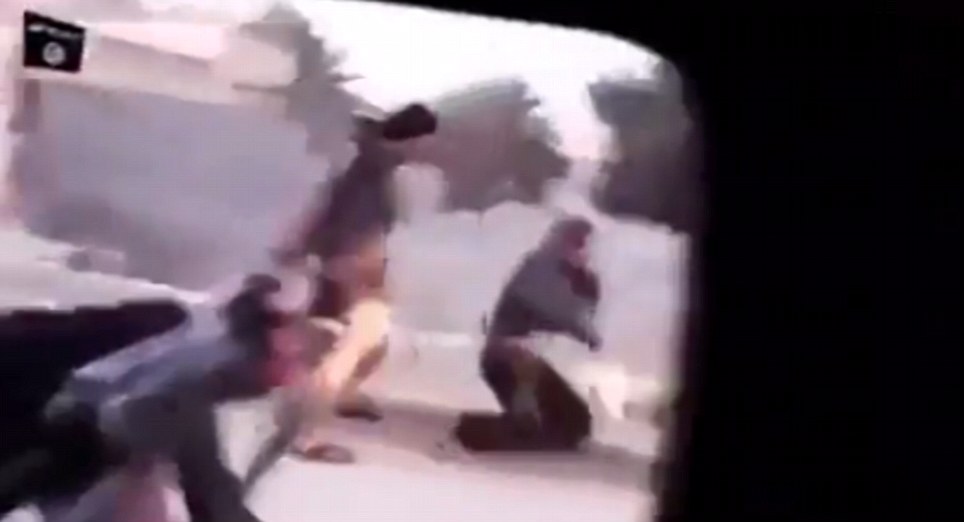
Blurred image stills of footage of ISIS militants gunning down pedestrians as they move into cities in Iraq. I've seen the original footage. It's not pretty and please believe me when I say it's not something you want to go looking for. Well, maybe you should, if that's what it takes to make you realize people are suffering right now because we're letting these brigands run rampant over the innocent.


With all the necessary education, I would now like to make the case - in conjunction with what else I have said about the situation on our Facebook, Tumblr, and YouTube channels - that military intervention in the Middle East aimed at eradicating Islamic Militants and undoing the damage done is not only just but a moral responsibility of the United States of America.

I shall begin with how, according to the Just War Doctrine promulgated in the Catechism and supported by the Doctors, Fathers, and Theologian-Philosophers of the Church, an armed intervention with the goal of destroying Islamic Militant groups by the United States of America would constitute a Just War. We will not be discussing strategy. That is a topic which requires full logistical information and such which I assure you, none of us here reading this blog are capable of getting or grasping, and even if they are, they're not allowed to talk about it. We can pipe-dream and speculate all day long, but what will and would work is ultimately inconsequential. In the first place, we must establish going to war is just in the first place. Furthermore, we shall assume for the sake of argument that the United States would also follow the guidelines hitherto established for a war to be just in practice (as unlikely as that is, given precedent). Right now, let's get some base for doing anything in the first place.

1.) The damage inflicted by the aggressor on the nation or community of nations must be lasting, grave, and certain.

This one is interesting because it is preceded by saying these are the requirements for legitimate use of military defense. This could mean either two things, or both: that the enemy we are fighting against must have done something extraordinarily damaging which warrants violent retribution or that whatever we are going to unleash upon our opponent must be a blow crippling enough to stop an immediate resurgence, which could create a situation of total unending war. Both seem sensible.

Either way, the Islamic Militants have done lasting damage to the "community of nations" in the Middle East, so much so that one would have to be living in a cave with no internet or cable or human contact for thousands of miles to not know about it. It's clear they won't stop until someone stops them.

2.) All other means of putting an end to it must have been shown to be impractical or ineffective.

History and present realities have shown that the militants will not stop without physical force opposing them. They have an outspoken goal of dominating the world through Islam. If we thought our presence caused their existence directly, we were wrong, as the recent attacks intensifying after our departure have shown.

3.) There must be serious prospects of success.

This is why I think the US would, ultimately, have to be the nation to carry out this operation, or perhaps a combined NATO/UN effort. No one else has the resources or manpower to pull this off, logistically speaking. There is no doubt in my mind that the United States could destroy the Islamic Militants. But they lacked a proper strategy to combat them.

4.) The use of arms must not produce evils and disorders graver than the evil to be eliminated. The power of modern means of destruction weighs very heavily in evaluating this condition.

This passage is explained later in the catechism as applying to chemical and nuclear warfare. Should the US disavow these two approaches, there should be no problem.


Since we can only understand the Catechism in light of the teachings of the Fathers and Doctors of the Church, let's cross-examine these points with those previously made by those who wrote on the same subject prior to the modern age.

Saint Augustine

For Saint Augustine, I think, the issue about intervention being just or unjust would be clear. I think he would have reservations about the United States of America or any member of its military carrying out the operation, since it is clear that virtue doesn't really factor into most of US history. I think more than anything he would think a Catholic force would qualify for the job.

Perhaps if the countries in question were willing to swear to abide by the principles of Just War, he could be convinced. Maybe even if it was left up to the direction of virtuous, chivalric generals he would be convinced. But it's true that even most of the Roman Empire wasn't perfect. So perhaps he would be willing to give it a chance. I think, if anything, he would agree inaction was not the answer.

Saint Thomas Aquinas

The Angelic Doctor didn't have much experience with war. I think key to him would be that everyone involve understand what they are fighting for: to protect the people in the Middle East - particularly Christians - and to remove a consistent threat to the peace of Christendom. It is not about a genocidal war with the goal being the destruction of Islam. Though Aquinas himself had a low opinion of Islam and considered Mohammad of as "a robber and a tyrant," and frowned upon Islam's tradition of conversion by the sword, I do not believe he would sign off on religious and/or ethnic genocide. If things started going bad, he would be the first to demand things be set right and everyone gets back on course.


Saint Bernard of Clairvaux

Seeing as how I mentioned Saint Bernard's defense for the Crusades, I feel obligated to bring it up again. He was a preacher for the Second Crusade and a staunch friend of the Knights Templar. I think out of them all he would be the quickest to say, "Of course you should fight the Mohammedans if they are oppressing Christians! Why aren't you already? Where's the King of France? What do you mean there's no king? Well, the Emperor's still here, right?"

So maybe Bernard would have a bit of future shock (my sense of humor aside). I think out of all the saints herein he would be most eager to get the ball rolling. He attributed the failure of the Second Crusade to a lack of faith on the part of the Crusaders and their own sins. I believe his first and foremost concern would be the piety and zeal of the fighting force assembled. He would perhaps also sue for the resurrection of the Knights Templar or some new militant order and petition the pontiff to reinstate the Templar Order itself (as per the bull that disbanded them, only the Pontiff can reassemble them). Speaking of Popes...

Blessed Pope Urban II

Maybe now I'm stretching it, seeing as how I didn't really mention him and only used that piece of art for the header image. But ultimately the right kind of Pontiff who can inspire people to do this is important. Let's really take a moment to realize how impossible and suicidal the mission of the Crusades was. Let's also realize that this was the guy who got everyone willing to sell their possessions, drop everything, and go fight to save their brethren. Ultimately, a war effort like this will need some head or international figure who can inspire people to see it through. Whether people like it or not, the Pope is still one of the most followed and watched individuals on the face of the planet.
I love Pope Francis, don't get me wrong. But I don't think unless he's really pushed out of his comfort zone he could grasp the fact that sometimes violence is what has to happen to end and prevent more violence. More than anything right now we need a Julius II or a Alexander V or an Urban II or an Innocent III who understands that sometimes talking just won't get things done. Even if it's not a Pope, we need some kind of person who talks big and walks big who can make people stand up and fight back.

Also, the Pope who called the crusades is a Blessed. I'll bet you didn't know that.


School of Salamanca and Adherents

I believe, much like Aquinas, the key issue for the Salamancans would be Saint Thomas': do people know what they're fighting for, and are they prepared to act by the guidelines of Just War? I think the Salamancan adherents would be very picky about who is involved and who isn't. Who would try and exploit the situation for personal gain, rather than looking out for the Iraqis and Middle Easterners as well. I believe they would be partial to Spain. Perhaps they would be upset at the current state of the country. Maybe more upset at the state of their university. But if anyone would play moral police first, I think it would be them. Perhaps a committee or court of these guys monitoring the situation, or simply being a part of it, would be valuable to the whole process.

In Conclusion

We have a clear responsibility - the US most of all - to stop the situation in Iraq, as I've said before. This whole post was simply to point out how it would be very difficult for a Catholic to say that armed intervention is wrong carte blanche. Particularly when we have a very proud history of benign, imperialistic armed intervention which has the capacity to really get things done. Even if it has been stained, there is always a chance to do better, and the ideas are in place against which to judge others who attempt to aspire to them.


Perhaps this whole situation will blow over with time and the Jihadists will be driven back, run out of steam, or get torn apart internally by religious differences and simple power struggles much like the Ottoman Empire was. But I can't say; I can only work with what I know and what we have before us right now. What we have before us is a terrible situation that is our responsibility. We have to do something. We have to stand up and say this is our mess and for honor and justice's sake we're going to clean it up. If it takes temporal glory and benefits to convince someone to fight, in the least one can see that magnanimously going across the seas to defend innocent, free peoples from tyrannical forces of evil is right and just. After all, that's the official take on us in World War I & II, and it is celebrated to this day. So how is this any different in principle?

Even if the US doesn't have the proper precedent or reputation or modus operandi to do this without it getting worse, we as Catholics can still hold up our own ancestors with pride who fought and bled for just causes without second thought and ran to the sound of the battle for King, Country, God, Church, and Christendom. We can show them to the world, strip away the libel and slander applied to them and say, "It can and has been done; we did it before, and if God Wills It, we will do it again."


Friday, April 4, 2014

The NSIR: Part 2

Who We Are, and What We Want to Do

Pope Paul VI receives the Noble Guard January 7, 1964. Prince Alessandro Odescalchi carries the flag.
In our last post on this topic, we covered what the NSIR's name itself means. Now, I would like to address our goals and what we want to see accomplished. These will be generally specific, in that they will all be things we actually want to see done. The overall mission of the salvation of souls and the conversion of all along with the defense of True Doctrine, obedience to the Papacy, and all that is overarching and understood; these are more things we would actually like to achieve. So without further ado, let's start with number one.

1.) The Establishment of Catholic Nation

Map of Europe, dating from the Maximilian Period of the Holy Roman Empire.

A nation is not just a state with fixed boundaries. A nation can be made up of a cultural group or ethnicity. This is what we mean by a nation. Though in subtext we would some day like to see the rise of a legitimate and authentic Catholic State to represent the temporal interests of Catholics in the world at large, what we aim for above that (and maybe more realistically) is an international community of Catholics brought together in their cultural heritage as Catholics, in spite of their temporal differences (race, language, state of origin, etc.). Why? For the same reason Israel came together and returned to their own ancestral homeland; we do not wish to be trod upon any longer. In an age where "tolerance" seems to be the watchword, we want what seems to be the same rights and abilities being afforded to everyone else. We want our own representation and so that the followers of our creed are left to practice as they wish in the security that community affords. From internet think-tanks, forums, and social networks to physical communities, radio stations, television, literature, and cultural appreciation societies; from legal counsel to a reliable defense against physical attack. Many other religions are being afforded special legal status in the public square. Why should not Catholicism be afforded the same?

2.) The Protection of Catholic People and Places

Swiss Guard

In recent years, vandalism of churches and holy places has risen at an alarming and disturbing rate. Clergy and laity alike have been assaulted and killed not just in uncivilized corners of the world, but in other countries as well, without so much as a twitch of a finger raised in their defense. Churches have also been vandalized. It's as if the attitude with Catholicism is that, "Oh, it's the Catholics; they deserve it." How long before these minor incidents explode into full-on riots? How long before we see another Massacre of the Latins in our time? Who wants to bet there won't be an ounce of defense for or sympathy concerning Catholics being killed in the streets and worse? This is a problem the NSIR wishes to rectify, by forming a private security group with the purpose of taking those Catholic men who meet our qualifications and turning them into a disciplined militia tasked with the defense of Churches, holy places, and Catholic peoples (laity and clergy alike) from undue and unjust violence. We intend to work in full cooperation with local and international authorities to maximize our effectiveness. I've spoken on this group before, and I urge you to check that editorial for some information on it before you jump to conclusions.

3.) The Healthy Growth of Catholic Cultural Communities

Corpus Christi Procession in Seville
There are many regions where Catholics are in fact a majority, though they might never realize it for how scattered they are. Or if they are concentrated, they have no focal point. The NSIR wants to help fix this by not only establishing its fraternity in dioceses and parishes all over the world, but by increasing the knowledge of Catholics of their own culture and faith. We wish to bolster their confidence through knowledge, and host events that will help not only the disadvantaged in communities but bring together congregations who otherwise might not know one another beyond those days they are bound to attend the Mass. These community-organizing campaigns will also entail re-awakening cultural and regional-specific devotions and inspiring a greater sense of piety and catholicity in parishes. In this way the NSIR transcends political function and actively assists in the Church's salvific ministry. Ultimately, we hope to see entire communities change for the better by strong Catholic influence.

4.) The Application of True Catholic Social Justice

Conques, Abbey Sainte-Foy; Christ in Judgement.

Too often the word, "Social Justice" in Catholic political circles has become synonymous with Marxist and Communist trends in the Catholic Church. Well, no more! The NSIR seeks to clear the good name of the meaning of Social Justice by actively working to propagate and apply the ideas of governance and economics as espoused by the Catholic Church in such documents as Rerum Novarum and Catholic thinkers such as G.K. Chesteron and numerous others! To say the Church has a wealth of teaching on the subject would be too great an understatement. We are neither Far Left nor Far Right; we are our own side, and seek to walk the middle narrow way along the path the Church has laid for us with peace toward all men of good will. Through legitimate political activism and demonstration in the immediate (protests, marches, etc.) and in the long-term (the establishment of communities of Catholics dedicated to living in communities structured around the ideas of Catholic Social Justice, etc.) we hope to show that the Catholic way has not been tried and found wanting but found difficult and therefore untried. It is said that those who lived in Islamic powers surrounding the Crusader-States often fled to the Franks, preferring their government to that of the Sultans, Emirs, and Caliphs. We hope to obtain similar results by the grace of God.

5.) The Defense of the Church in the Public Square

The Church often finds herself under attack in today's day and age, often without any legal weight on its side - unlike its opponents. The NSIR seeks to remedy that by bringing together the best and the brightest to defend the Church in the public square and the legal courts. No more will those proponents of the Church be silent or ham-stringed, or confined to their internet lobbies; we shall boldly step fourth to defend the One, Holy, Catholic, and Apostolic Church whenever she is unjustly accused or warred upon.

6.) The Creation of Reliable Secular Partners for the Catholic Church


Seal for the Tribunal of the Holy Office of the Inquisition (Spain)

Perhaps the most controversial, we wish a return of reliable and strong secular cooperators with the Church. She was best able to manage and protect herself when she had one, particularly in the form of the Holy Roman Empire and the Holy Inquisitions. For the physical protection and propagation of the Church, the NSIR shall exist. For the doctrinal purity of the Church, a valid inquisition will be set up with the full consent and cooperation of the Papacy, as was the first. It will be constructed not so much with the goal of burning heretics, but as a system of "courts" designed to review parishes, pastors, media, literature, and institutions claiming to be Catholic for their doctrinal uprightness. The Inquisitions will exist to guide and advise pastoral leaders in making sure that the fullness of faith is taught from the pulpit and those most qualified are given positions of teaching. Made up of qualified lawyers and individuals who make their chief principal area of study Catholicism and its teachings to their most orthodox adherence (among others qualified for other tasks to be announced), it will also provide legal counsel for the Church in internal disputes. It will help to investigate and prosecute sex offenders within the Church, financial corruption, and other acts of mismanagement that bring scandal and harm upon the faithful. It will also work to rectify these wrongs to the fullest extent that the law provides. In essence, it will exist to directly help the Church and its members achieve salvation and bring it to others by maintaining pure doctrine and a pure Church to bring it. The Church sorely lacks this today and has suffered for it. We believe it is necessary if the Church will curtail the scandals that have damaged it in recent centuries. Rest assured, the model for the Imperial Inquisition is largely in flux right now, as are its full scope of authority. It is an idea that, at this time, remains to be discussed with those who bear the authority to legitimize it.


As for the NSIR itself? Through its other activities it will also see to the growth and health of the Catholic Church through its programs, campaigns, and the living witness of its members; the Inquisition would only be a small part of its institutions. It will put all its energy toward cooperation with the Church so that it might best accomplish its mission.

7.) The Upholding of Catholic History and the Heritage of its Children


Re-enactment of 16th-century military drills conducted by the Knights. Fort Saint Elmo, Valletta, Malta, 8 May 2005.

There is much glory in the past of the Catholic Church and many traditions present in ethnic groups that stem from Catholicism's influence upon it that are either forgotten, suppressed, or simply lose significance in the wake of the pervasive and vulgar secular culture of the day. The NSIR seeks to rectify this in two ways: by telling all of the victories, triumphs, and good deeds of the Church and making them real and visible for the people of today. In doing so we also wish to return Catholic values to those who have forgotten them - mostly Catholics themselves! We will uphold the great achievements and contributions of Catholics in all cultures, even if it is simply that it brought Catholicism to a people previously ignorant of it. Artistic, scientific, philosophical, administrative, architectural, legal, military; great Catholics canonized and not have contributed immeasurably to the world and deserve to have their contributions made known to the world so that they can inspire another generation of great Catholics to action and realize that their faith - their heritage - is a pearl of great price that should not be carelessly cast to the swine. This will include a glorification and appreciation for those stories and artworks and individuals who influence the faith or display its virtues and values - knowingly or unknowingly.

8.) The Expansion of Catholic Education

After a rather depressing incident (among others) the need for strong, authentic Catholic formation of
Charlemagne at the Palace School
the young is becoming more and more apparent. Catholics need good, affordable, reliable schools to send their children along with effective home-school programs to in addition to strong catechism in their own parishes on Sundays and in youth programs throughout the week. As such, the NSIR makes supporting such endeavors through publicity, funding, and legal privilege a priority. In the future, the NSIR hopes to fund and operate its own institutions. Non-Catholics would not be disbarred from attending these institutions, it is pertinent to remember, as long as they can be content with the Catholic environment.

Closing

I believe that covers everything for now. Of course, immediate and short-term goals are bound to change on the day-to-day, but I think this is a strong starting point for helping others to understand where we want to go with this and what we plan to do. Do you have suggestions? Is there anything we missed or didn't clarify? Please, comment and tell us. I hope this clears things up, and helps people get an idea of what we want to accomplish and see come to fruition.

Two-Headed Phoenix. Found this completely by chance. It's very close to what I'd like for our own symbol.

Thursday, March 20, 2014

Caesar Alloquitur: The Bear is Stirring; Raise up Lion of Judah

 Persecution of Ukrainian Catholics in Russian Crimea

Warcraft - The Lion of the Alliance, King Varian Wrynn. Relevant because Lions, and because there was a time when the Alliance and Warcraft was still awesome and had potential. Now it's something of a disappointment. But more on point.

This is the second or third major Catholic news outlet to report persecution of Ukrainian Catholics in Crimea since the Russian Occupation. Previously, I was a staunch supporter of Putin's annexation of Crimea. My understanding of the whole situation has been simple, and to the point: Russia has as much a right to protect their assets as any other country, especially against a rogue government.


St. Bernard preaching the Second Crusade painted by Émile Signol.

But this is a different story now. I've always been wary of Putin. The man's not the religious conservative people want to play him up to be, not by a long-shot. He's an amoral opportunist, and he's garnered support only from bitter conservatives outside of Russia who are desperate for a leader to rally behind. I've refused to worship him as some Peter the Great/Savior of the Right like many have been doing.

Maybe the Russian government has nothing to do with the persecution of Catholics. Maybe it's just some overzealous Pro-Russians in the Ukraine. Maybe if only Stalin knew about all the people being hauled off to Siberia, something would be done about it (an old propaganda tool used by the Soviets when Stalin was in power, for those who don't get the reference).

I for one am sick of Russia deciding to invade the West every few hundred years for the same reasons: land that isn't useless and ports that aren't frozen. They can bloody well learn to overland trade or get over themselves, or maybe ditch some of that useless frozen wasteland for some land that is actually useful.

I don't really have love for any other country in the world right now, for various reasons. But I'll put it like this: I'm willing to throw in behind any country at this point that is willing to humble the Russians once and for all. It's time their westward invasions - after the fashion of the Mongols who ruled over them nearly a thousand years ago - were permanently put to a halt. It's time that the Moscow Patriarch - that belligerent schismatic who's opposed union with the One, True, Catholic, and Apostolic Church at every attempt to put it into effect - saw Moscow burn as he probably wishes we could see Rome burn by the hands of the Russians. It is time for Russia to be made to behave like a civilized nation and for its history of violent expansionist wars to be ended.

Before you all run down to your nearest recruiting office, I'd like to make it clear that I feel like against all odds, the Russians will win. Moscow will seize on these victories to declare the glory and strength of the Orthodox Faith against the Latins and the Westerners. That is, unless something miraculous occurs.

Russia will try and make this a religious war; make no mistake about that. They will do so to appeal to conservative groups in their opposing countries. They will do so to stir up the Russians to war. Do not underestimate them; what Russians lack in strategy or technology, they make up for in sheer ferocity and zeal for their causes. They will fight to the last man and any invasion of Russia would be near-suicidal without proper planning.

But what is this miraculous thing? Conversion. The world must get on its knees and turn back to the True Faith. I have foreseen that Russia may be perhaps a scourge to us, a faithless and sinful world. God would sooner, I think, let the Orthodox have a victory than the Secularists, given the state of things. But if the undercurrent of Authentic Catholicism can be grasped and let loose, then we might get something. Spurred on by victories over the Russians, we might just experience a religious revival.


The Conversion of Saul, a fresco by Michelangelo, 1542–45

However, such a thing is not an overnight phenomenon. It will also not be achieved by milquetoast Catholics afraid of their militant tradition or unwilling to commit fully to the Faith. It will also not be achieved by those Catholics who stand against the Church and its Holy Pontiff. I suspect this great conversion will not happen without many losses and great pain. I foresee that perhaps those countries who oppose Russia will be humiliated and defeated, initially if not permanently. Even if we all converted, I think we would first suffer a few terrible defeats, to test the sincerity and strength of our commitment.

Regardless, ultimately, nothing here matters but the salvation of souls. Which is why we must do all within our power to protect the Eastern Catholics who provide a witness against the Orthodox. Regardless of even that fact, they are our neighbors; brothers and sisters in the Faith, and as such it is our duty to support any effort that ends or involves their protection against their oppressors.

As I said before, I now support any and all attempt at pushing Russia out of Crimea. That is, unless Russia owns up to this and it ends up being the result of mob violence and not systematic - or permitted - persecution by the Russian government. The first few months of even the most benign occupation are never pretty, and it may remain that there are some kinks left to work out. But if there aren't, and Russia turns up being fully for conquest of Eastern Europe and the extermination of its Catholic populations, then you all know where I - where we - stand.


Saturday, March 1, 2014

What is the Imperial Militia of Blessed Charlemagne?

"Benedictus Dominus Deus Meus Qui Docet Manus Meas Ad Proelium Digitos Meos Ad Bellum"

Psalm 144

The Imperial Militia of Blessed Charlemagne has many historical and fictional groups it considers inspirations and forerunners either in ideals, aesthetic, or strategy. For me, one of those - at least for aesthetics - simply has to be the Imperium of Man from the Warhammer universe.

Introduction

Some sad news out of the Middle East today. More violence and more war waged against defenseless Christians in the Middle East, who's families and who's faith goes back to the Apostles and Christ Himself. Why? I'm well aware that the resurgence of violence in the Middle East ultimately has more to do with the United States stirring the pot back during the Cold War, but I think we have to understand that even before then Muslim violence against Christians is nothing new. The very Mohammedan religion commands violence against unbelievers. How on earth this didn't make anyone at the start conclude it was dangerous and should be absolutely eradicated from the face of the earth is beyond me. Most likely the logistical constraints of the times.

I've always agonized over the plight of Christians in other countries, even going back to when I myself was Protestant. I always asked myself, "If the United States is the great Christian nation, why aren't we fighting to liberate these people if our military is so mighty and unbeatable?" Of course, the simple answer is that America is not now and never has been a Christian nation. It was one of the first nations in the world to completely forgo religion as a cornerstone of its culture (Masonic influence excluded). If Syria proves anything, it's that America is most definitely not interested in helping Christians. It does, however, give a view into a frightening future. A future where an American Cardinal's prophecy that he would die in bed, his successor would die in prison, and that his would die in the public square might be all too true.

Torturing of Bl. John Sarkander by Protestants. Even if America had been a religious nation, it would've been Protestant, and anyone who thinks Protestantism can be relied on to run to the aid of Catholics really needs a refresher in history.

After becoming Catholic, seeing the persecution I could suffer just as a young man in a Protestant community, and seeing what others have suffered, I became doubly convicted something needed to be done. If nothing else, there needed to be somewhere or someone I could go to for comfort in this battle. This is what prompted the founding of the Novum Sacrum Imperium Romanum and its group on Facebook. Yes, it's a humble start, but it's something. But one of my greatest desires is to see the holy places protected from assault; to defend the clergy and the churches from those who so commonly assault them in great and minor ways in today's day and age. This was the thought behind the Imperial Militia of Blessed Charlemagne. It's quite clear that in the present day and age we can't rely on others to defend us. We must seize our natural rights as human beings and take up arms on our own behalf.

Landschneckt
Now I understand that this is a controversial move for a multitude of reasons. Christian Militia groups such as the infamous Hutaree have not exactly done service to making the idea seem plausible. Ignoring that they're not Catholic and therefore should have no bearing on us, these are legitimate concerns that should be brought up and I would be unsettled if they weren't. "All clear" basically means, "ambush we don't see," after all. This article will attempt to lay a basic outline for the IMBC out and try and explain what they're to do anyway. Bear in mind we don't have any official symbols worked out yet (though there is one, and I lack the skill to draw it well) so I'll be posting things from other armies I consider inspiration for the IMBC in some form or another. Hopefully this will help you get a feel for what I'm trying to accomplish here or what the finished product will look like.

Purpose

"Helfen, Wehren, Heilen."
The purpose of the IMBC is summarized in its motto; one of my own creation: "Flagellum Diabolo, Vallum Ecclesiae." It's Latin, of course; in English it translates to, "Flail to the Devil, Wall of the Church." It is meant to defend the Church and fight its battles in a way not suited to men of the cloth or lay theologians. The fact is that there is no single shred of doctrinal or dogmatic evidence that Catholics are obliged to not defend themselves from attack when they are able to do so, or to defend others when they are able to do so. There is, however, a lot of precedent to say they can.

The four de Charette brothers, three of whom served in the Pontifical Zouaves, and one as a Papal Dragoon.
The principle activity of the IMBC would be the protection of clergy - religious and clerics alike, of all rank and station in the Church, whenever and wherever possible - and the holy places of the Church - shrines, churches, cathedrals, etc.. Whenever and wherever possible, the IMBC would seek to defend its religious and churches twenty-four hours a day, seven days a week, and 365 days a year. One might liken it to a private security company that takes out contracts for businesses and high-profile individuals who can afford the asking price. However, the IMBC will not be expecting the Church to pay for its services. Donations will always be accepted as charitable gifts, but no one who receives the protection of the IMBC will ever need to worry about a bill.

Artist's Rendering of Romans Building a Road
That is not to saying providing militant protection to the Church will be the Militia's only function. Surely, such a thing would be redundant or even useless in some places. There's an old saying: "No one does things like the military does." Growing up in the shadow of a military base, I've learned that quick. You want the best camouflage in the world? Head on over to the Army Surplus store and by some old camos. You want a good mess kit for a camping trip? Try an old military mess kit. You want a good trench coat? Get an old military-issue one. Want the best knife you can take anytime, anywhere? Head over to the PX and buy an army knife with a steel grade so high it's issued to pilots so they can cut their way out of their aircraft in the event of a crash. It's even got a little handy button on the holster to keep it from slipping out when you don't want it to.

A depiction of the Order of Malta Knights of uniforms
Most of Rome's great infrastructure was constructed by the Legion. The Roman Road still stands today, along with most of its bridges, particularly in Spain. The military simply knows how to make things that last and can take punishment. It might not always look pretty, but you can bet it will get the job done. This is something I want the IMBC to do as well. They can very easily be free labor should a Church or members of the community need repair work done or something that requires strong, capable men to do. In this way, the IMBC garrisons within parishes and dioceses will quickly become valuable members of the community as they assist in keeping things up and running not only for Catholics but for other charity groups as well. In general, in fact, it would be hoped the IMBC would be active members of their communities and look for ways they can help those in need however they can; fundraisers, soup kitchens, what have you.


Organization

Grand master & senior Knight Hospitallers
The NSIR itself is heavily centralized, or intends to be, with its authority figures appearing as leaders of groups within their respective communities. The Imperial Militia will work in a fashion similar to this, with regional leaders operating their own garrisons and groups in cooperation with the clerical authorities and local authorities to work efficiently and do their duty free of obstruction. Ultimately there may be some sort of, "Grand Marshal" position. Someone who can in union with the most powerful marshals make decisions regarding deployment and what have you in a crisis situation. As far as ranks go, it will most likely mirror other militaries in its officer and non-officer structure. It will be simple, streamlined, and well-suited to smaller numbers. Not bulky, but simple and straightforward so it's clear who's in charge of what and who.

Membership

A Knighting Ceremony
Any and all physically capable Roman Catholic men will have a place within the Imperial Militia of Blessed Charlemagne, provided they can make it through some basic training and show competency. Of course, some kind of screening for mental and physical defects will have to be taken into account, much like with professional armies. We need cool heads and disciplined bodies to make this work. Background checks of course will be done, as we don't want provocateurs within the Militia who are just there to stir up controversy and make us look bad. There will be public investment/knighting/swearing in for members, of course. I would like for our first members to be prior military servicemen of some sort or another, so that the militia can be run by people who - for lack of a better word - know more about running something like this than me.

One thing I certainly want are mounted divisions of some sort, for parade functions.

The IMBC will essentially focus on combined arms tactics adapted for certain areas and terrain. So, artillery, cavalry - armored and otherwise - so composition within various garrisons and regiments will differ greatly based on region and the discretion of those in charge of such things. If there is a noted land pilgrimage route, mounted patrol units might be necessary. If it's a metropolitan area, it will most likely be a largely infantry affair. Those militias who find themselves in areas with gun ownership laws that are more liberal (and by that I mean open) will have greater leeway in terms of what they can get their hands on and thus may be differently equipped. Militias may find themselves equipped differently based on regional laws and firearm codes. As always - except in cases of great strife - will always abide by the laws of the countries in which it finds itself in regards to militias and weapon ownership as well as self-defense. In many areas members of the Militia may well find they have only themselves with which to defend their holdings.

Spanish Tercios Repulse French Cavalry

Membership will reflect these realities, and while numbers are always a plus, who we take will be determined based not only on their own qualifications and capabilities but what the Militia needs. If it's getting to a point where there are too many in one spot, members may be moved to different places in terms of where they carry out their duties, or they may be relegated to "reserves" of some sort.

Esprit de Corps

Louis IX Before Damietta. After leaping courageously into the sea in the attack at Damietta, St. Louis and his army pause to offer thanks to God.
This is not the Boy Scouts. This is not a social club. While the NSIR itself is not entirely militant, and members would certainly be - I hope - proud Catholics, the Imperial Militia of Blessed Charlemagne is for those men with a serious interest in fighting for the Faith. It is for those willing to lay down their lives and fight for the Faith when the time comes for that. They will be the first to be martyred, and the last to very last to leave a place where the Christian Faith is under physical attack, making the way safe for those brethren who would flee to flee and take the Sacred Relics with them so that they will not be destroyed. It is for the men who feel called that their place is to die in a pile of smoking brass in defense of the Christian name and faith; they die standing when all others have fled. Before every struggle they will pray to God for victory in humble submission to his will, be Reconciled, receive the Eucharist, and be blessed along with all of their equipment for the task at hand. After every victory they will pray for the repose of the souls fallen. On the march they will pray the Rosary. No mountain too high, no battle too hot, no siege too heavy, no bridge too far, no objective impossible, no sacrifice too great, no enemy too terrible. Inspired by their ancestors and steeled by their faith, they will never rout or forsake their orders.

The Battle at Jasna Góra in 1655. Painted by Januarego Suchodolskiego


At the center of the life of the Militiamen must be devotion and piety, for it is by these they are made strong. Almighty God is the true giver of victory; the true giver of life and death. It is ever paramount that His aid and His blessing be sought and maintained. Not only are the men of the Militia to be masculine, stalwart men of chivalry and honor but also pious. They of all men must be those who do not wish to be the Jonahs that bring the storm upon others as a result of their sins. Battles are won and lost by God alone. We must simply be on hand to fight them.

"Venis, Vidi, Deo Vici."
A fraternal brotherhood of men who want to give their lives to a higher calling: the defense of Christendom. That is what being a Militiamen will be all about. They may not be professional soldiers; they may not live in a barracks. They may have other jobs or responsibilities. They may have families or other obligations. But they will always be Imperialists. They will always be soldiers of God.

Uniform

I really like this plumed helm.
Palatine Guard Uniform
In regards to uniforms - which I have thought about and posted about before on the NSIR Facebook page/group - I have given it thought. There will be a standard overall, but I would like to be able to allow uniforms and standards to be regional based on the cultures within those areas and their historical expressions of Catholic militancy (France, England, Poland, Spain, etc.). Special dispensations will be granted to certain chapters in certain regions to allow variety to take place within the various regiments and so-forth. However, this is an issue too diverse to address in full detail as it will have to be adapted. Overall my policy is thus: aesthetically pleasing, but not at the cost of practicality and utility, but without being ugly.


Warhammer 40k Mordian Iron Guard 22nd Rgt Cosplay. I've always liked the Mordian Iron Guard uniforms as a good basic idea for what I would like the uniforms to be like.


 FAQ

"Aren't You Promoting Religious Violence? What makes the IMBC different from Religious Extremist Cells?"

The IMBC nor the NSIR promotes active violence towards members of other religions, nor does it promote violence against the State, nor will it ever support revolution against a lawful government (in most all circumstances). It does not seek to be a tool to use intimidation to influence others. It is a purely defensive and reactionary group. The only case I would ever sanction violence against any group would be if they openly declared violent, physical war against the Catholic Church. I don't mean in reference to, say, the violence of members of Islam and using it to condone violence in general toward all Muslims. In that instance, militiamen only in regions where the violence is going on would fight, and even then only against those who come armed against Catholics and the Church. The IMBC does not and never would in a war-time situation commit wanton violence against civilians or civilian population centers. The IMBC will strictly confine itself to Church property and the property of the clerical establishment as well as those authentic Catholics who request it (but only then in a very controlled and limited fashion) in regards to its security details. You will not and never should see armed patrols in civilian areas. That might, of course, be different in the event of war or emergency in the case of a breakdown of law and order. But the IMBC is strictly reactionary as a rule, and does not seek to "strike out" against others but simply protect the Church.

"Is This Even Legal?"

As far as I'm aware? No. Right to Assembly is a thing in most Western Countries, and Private Military Companies and Private Security Companies who do far more questionable things than what the IMBC do are not illegal, so I don't see how it is. I can only speak living in the United States, where militias are not uncommon. So long as you don't break any actual on-the-books laws, there's nothing wrong with one forming, at least as far as I'm aware. Still, this is why I need more experienced people on board. As for talking about it? Not in the United States, as far as I'm aware. I haven't advocated breaking the law, or violent overthrow of the government. So, yes, legal.

"What if [Insert Worst Case Scenario Here]?"

"Hard Cases make Bad Law," as they say in the court system. The fact is most of the worst case scenarios you can think of can't and won't happen. This is why laws in the West are made based on precedent and not on, "What ifs." It's simply easier and more practical to make laws based on what has actually happened rather than what might happen.

"You Compared the IMBC to a PSC. So Catholic Mercenaries?"

Not exactly. The actual chances of us being wealthy enough to pay people are slim to none. It's a volunteer militia, or at present is structured to be one.

"Why Not Just Rely on Local Law Enforcement?"

Ignoring completely response times or how seriously law enforcement take cases where religious are assaulted or churches are vandalized, there is a large precedent for local authorities being unreliable in cases like this, especially in countries where law and order isn't a luxury the Faithful enjoy, or when the government itself persecutes Catholics. Even in the United States during the 18th and 19th centuries, "No Popery" gangs who mugged religious and clerics or vandalized monasteries, convents, and churches got a slap on the wrist or were completely ignored. There's a reason most religious communities establish their own constabulary, if they're something like Kibbutzes or Amish communities. Nevertheless all regiments will cooperate with local law enforcement as best as is possible and reasonable to apprehend any and all aggressors against the Church or its property. Unless the assailants are armed, dangerous, and aggressive, lethal action will not be taken - unless for some reason local law enforcement and state law allows that regardless. Criminals will be apprehended under the usual Citizen's Arrest, the proper authorities will be contacted, and charges will be pressed.

"How is Housing Going to Work?"

Well, I would like a situation where base camps of some sort or headquarters in regions were applicable and could be constructed. A permanent stronghold would be very nice. But in terms of offices and actual quartering, it probably won't be an issue and will be worked out with the local religious authorities. They're the one's with the deeds after all.

"What if You're Not Wanted?"

Then we let them know our offers for protection always stand and go about our business elsewhere. We're not going to force ourselves on anyone who doesn't think they don't need us. We may be active in a region, but we simply won't be present at a particular church or community and we will always be on hand to offer assistance. It's not like this thing even has the Papal stamp of approval yet or anything, which is something I do hope to get in the future once we transition into the physical world and out of our think-tank here.

"What About Women?"

We won't be accepting women into the Militia for a variety of sensible reasons. However, there will be a companion women's lay order set up; the Ladies of Saint Clotilda. But that's another story for another time.

"How Will You Fund This?"

Sell merchandise, literature, advertising, general self-sufficiency; that hasn't been worked out yet as we don't even have any prior service people interested in this in the first place. That's what this blog was for; generate general interest.

Closing

Henri de la Rochejaquelein, by Pierre Narcisse Guérin. Vendean Hero.

This is something I've always felt strongly about. It is something I hope will garner a large amount of interest. It's going to be a long climb, but I'm confident that it can be done. We just have to become organized, get interested people on board, and get the ball rolling. Please share this blog if you want the IMBC and the NSIR to succeed, and tell your fellow Imperials and friends and anyone else who might be interested.

Let us pray that we may succeed in our goals; not to us, not to us, but to God be the glory.


Templars at Montisgard, 1179