Search the Archives

Tuesday, January 28, 2014

The NSIR: Part 1

What's in a Name?

Saint Maurice, Patron Saint of Chivalry
Hail, readers! As some of you may or may not know, I've been hard at work on a constitution for the Imperium recently. Unfortunately, every man must learn his weaknesses at some point and I've certainly discovered one of mine: writing legal jargon. My prose is simply far too flowery for legal papers. So, the official Constitutio is on hold as of now. However, I am still seized by the same sense of urgency that propelled me to write it. Ergo, I have decided to write a series of posts explaining what exactly we are. All readers are encouraged to share the post; even if you hate it, I really don't mind. Bad Publicity is still publicity, after all. The main goal is to develop a platform of sorts for us, so that we can with confidence know why we're here and what we're doing.

So, what better place to start than the beginning: why we are named what we are named.


Meaning of Our Name: Novum Sacrum Imperium Romanum (New Holy Empire of the Romans/New Holy Roman Empire)

The Phoenix; our official symbol.

Novum (New): We are not a novelty. We are a rebirth and resurrection of the noble tradition of temporal defense of the Church. We are new in that we are a thing unseen in the modern age; we are unheard of and uncommon. We are exceptional in who we are and what we seek to accomplish.

Henry II, Holy Roman Emperor

Sacrum (Holy): Our cause is holy; the defense of the sacred. It is an upright thing to protect that which is sacred; to forbid pearls from being cast to the swine. We seek - though at present we do not have it - the blessing of the Church to carry out our mission, as the Holy Roman Empire received to defend Christendom.
Austro-Hungarian Empire

Imperium (Empire): An Empire is defined as a geographically extensive group of nation-states and nationalities brought together under a single ruling government. The Hapsburg Monarchy of happy memory embodied the idea of Catholic Imperium in that it brought together numerous nationalities and races without discrimination and united them via their common faith. The Hapsburgs ruled their empire via autonomous rulers and nation-states, all of whom held their allegiance to the monarch. In a similar fashion, this is what we aspire to be. We are a nation of Catholics bound together under the Church who wish to go above and beyond the vulgarity of the world in our aspiration to be Saints and do the will of Christ in the world.

Romanum (Roman): We are Roman in not only that we are Roman Catholics, but also as the Church did when it filled the power vacuum left by the emperor, we are inheritors of Rome's legacy as a force for civilization, justice, and order in the world. We seek to spread the Faith and the Pax Christe across the world as Rome spread Civilization and the Pax Romana.


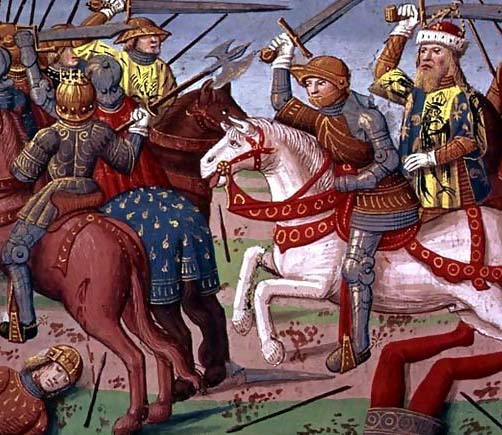
Battle of Milvian Bridge

In Conclusion

Roman Legion battling the Barbarian Horde
The NSIR seeks to be a militant force of Catholicism. Not seeking to be a pervasive political ideology, but rather a nation born out of already existing Catholicism. From the grass roots, a physical movement of Catholics towards identifying themselves as part of a larger nation (while not necessarily a state) of Catholics. Catholics who wish to live the authentic faith in community with like-minded fellows and have all the comforts, support, and security that comes from just such a thing as a community. We are tired of our voice being silenced, our churches being ransacked, our clergy assaulted, and of our history being maligned in pursuit of a real pervasive and political ideology. We have come together to be unbreakable as one; united we shall stand against the enemies of God, Pope, and Church.

Thursday, January 16, 2014

Caesar Alloquitur: Political Parties and the Church

The Necessity of a Temporal Bulwark

Painting by Karl von Piloty showing the foundation of the Catholic League
The most oft leveled accusation I hear leveled against the Church is that she concerns herself too much with politics. When you consider we're a religion that has been broken, beaten, and scarred by various apathetic governments and outright cruel ideologies, it becomes a bit more understandable why we would care so much about politics. From the moment it dawned on the early Church that Rome's infrastructure and the benefits it afforded its citizens was the only reason Christianity was able to spread as quickly as it had (speaking completely in temporal terms) and with Constantine's Edict of Milan, it became clear that the Church benefited when the government was in cooperation with it.

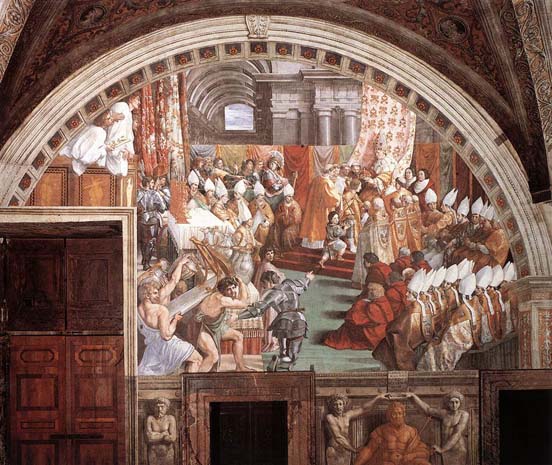
Coronation of Charlemagne
Such was the logic behind the coronation of Charlemagne as Holy Roman Emperor. In the aftermath of the fall of the Western Empire, Europe's future looked bleak as the dark forces Rome once held in check now had freedom to plunder as they pleased. The monasteries had successfully acted as repositories for the wisdom of not only the ancient world, but that of Christ. They formed missionaries who went out to witness to all peoples as Christ commanded. But that mission became strained as monasteries were raided by vikings and those Christian communities that formed were put down by pagan chieftains.

Jean Alaux (1785-1864, French) The Baptism of Clovis
But God had not only illumined the hearts of the common man, but the hearts of kings. Men who had the power and ability to protect and support the Catholic faith in a vital way. As St. Bernard of Clairveaux would postulate later in defense of the Crusades, it would be a sin against one's neighbor to not take up arms to defend the Faith if it was right and just to do so and one had the capability of doing so. The same can be applied to any action of supporting the faith; if you are capable of doing so, why do you not?

The Church and Politics

German Catholic League Colors
Going back to the Reformation, when Catholicism's influence in the temporal sphere was declining and Catholics were suffering for it at the hands of bloodthirsty, vandal Protestants, the Church has always sought to be active on the behalf of the Church. The various, "Holy Leagues" and "Catholic Leagues" established throughout Europe and movements like, "Pilgrimage of Grace" in England show that Catholicism was not willing to go quietly.

But as political spheres changed, and it became quite evident that the majority of the royal houses of Europe were either Catholic and losing or in apostasy. Sadly, most of these royal houses were still valid sources of authority. Even St. Pius V's declaration that Elizabeth's reign was invalid and her subjects were not bound to her obedience didn't hold up with the arrival of the Stuarts. That was when things started to become murky.

The Catholic Church had suddenly lost its pieces on the chessboard, and was limited in what it had left. Those Catholic countries left could not reasonably embark on a campaign of conquest for the Church across Europe with justification, and those that could were either uninterested or otherwise occupied. In many places, the Catholics of the world were forced to look out for their own in rather unorthodox ways. Catholics resorted to choosing the side that was most on the side of the natural law, rather than those who actually were on the side of the natural law. It's a common practice that continues today, seemingly out of necessity.

But there's a problem with this: these parties aren't Catholic. No matter how closely their political science may mirror the Church, and no matter what side of what hot-button issue they are on, there is no Catholic side. It is true that up until the modern era, most countries in Europe had some sort of, "Catholic" party. But in most places today they don't exist. If they do, it is only in the history books.

Julius Echter von Mespelbrunn
The consequences have been manifold and clear. The Church has scandalized herself through her laity and even her own clerics by choosing sides in secular disputes that are not there own. It is something of a necessity; the Church must protect her flock and choose based on the expediency of the situation. She cannot ally herself with those who follow error, but she cannot leave her people defenseless or risk the safety of the Church. This is why I can understand Pope Francis' comments just a little: "I prefer a church that is poor and in the streets." It is the fact we are forced to keep the Church present so she can minister to the people of God that often leads to some embarrassing blunders.

But there's a problem: there are situations where neither side is right in an argument. Let's suppose a Hindu and a Native American who adheres to traditional beliefs get into an argument over the cosmic nature of the planet Earth. The Hindu claims the earth is supported on the backs of elephants, while the Native American claims the earth is on the back of a giant turtle. Both are obviously wrong in this situation. If an astronomer walks up to this discussion, what do you think he will do? Is he going to pick the side that makes the most sense or the side against the one that makes the least sense? No, he'll tell them they're both wrong and explain why and provide definitive proof.

This is what the Catholic Church must do in today's world. She must stop settling and do what she always does and did: strive for excellence.

The Solution

Julius Echter von Mespelbrunn's Coat of Arms; leader of the Counter-Reformation, founder of the Catholic League - Imperial Knight
The Catholic Church needs to realize it can't keep doing this. We are better than walking around giving other people a moral pedestal to stand on. We are our own ideas, and our own theology. We shouldn't go around justifying other people's stances for our own good and then turn a blind eye to the errors they preach. The Catholic Church must take a stand and form its own movement; a temporal arm, to see its will done and to protect it from aggression. This is what the New Holy Roman Empire - the Novum Sacrum Imperium Romanum - seeks to be. This is what it seeks to accomplish. Our stances are defined clearly and only by the teachings of the Church, and we apply them to our decision making in union with our religious forebears. We seek to help, defend, and heal the Faith. We are Flagellum Diabolo, Vallum Ecclesiae; Flail to the Devil, Wall of the Church.

Slowly the sleeping giant of Catholicism is awakening. We are preparing and we are gathering. Those who hunger and thirst for righteousness will have their fill, and the peacemakers will see the kingdom of God. Do you want to be a part of it? Are you tired of stomaching others because they are the closest to a, "moral right?" Do you want the real right? Are you tired of the political polarization within the Church, and ready to be able to say there are only Catholics and Heretics? With the Grace of God, the New Holy Roman Empire will be just that.


Armed procession of the Holy League in Paris in 1590, Musée Carnavalet.


Saturday, January 11, 2014

The "Jewish Question" and the "Final Solution."

There is a problem today among conservatives that simply has to be addressed.

Let's get something out of the way here: other than the fact I used two phrases very synonymous with antisemitism in my blog to get views for this article, I am not antisemitic. I never was, and no Catholic can be in light of the teachings of the Church - yes, even going back to the Middle Ages. You simply cannot be the violent antisemitic a lot of Traditional Catholics shamefully are. The mere fact that there are Catholics in the world who actually fawn after Nazism and the Fascist states of the 20th century shows a desperate need for some form of modern touchstone back to their heritage (even if its a poor one) and a serious lack of serious historical knowledge.

So if I'm not about to start spouting antisemitic canards and praising Nazism, what am I writing about here? A while back in December a news article crossed my desk concerning the State of Israel's decision to pay for abortions as part of its healthcare for all its citizens. Just yesterday evening, another crossed my desk; a commentary on the complete lack of response from, "the Right" concerning Israel's decision to pay for abortions. This was something I had noticed; in fact, I didn't get the first article from LifeSiteNews or any conservative news group, but from a leftist news group (I like to keep tabs on the ones that like to spew libel in the direction of the Catholic Church).

The article makes a vital point: why aren't we talking about this? It's a big deal, and it should send a big red flag up to lots of people. I'm going to talk about the ins and outs of why below.

Some Things You Should Know

First off, Israel is a secular state. It is not a religious one. Judaism is not the state religion of the country. In fact according to census data Orthodox Jews barely make up 20% of the country. Even then, the most conservative groups make up even less than that. That means Zionists aren't even the majority in the country. About 55% identify as, "traditional" (whatever that means) while 20% identify as secular. That means that most Jews that live in the State of Israel aren't all neo-Biblical Crusaders claiming they have a divine mandate to the State of Israel. Which is a good sign, as theologically speaking they don't have a right to it anymore.


Morning Prayer in Hurva Synagogue, Jerusalem. For how much Protestants fawn over them, there sure are a lot of icons in their synagogues.

So what does that mean? That means that for most of the Jewish people, they're there because it's their ancestral homeland and they think that they deserve the right to live there. Which would be, archaeologically speaking, correct; the problem is that the communities in the historical and archaeological field will never come to a consensus on this because it's a politically charged issue. In fact the State of Israel has banned archaeological digs around most of the country for fear that some other finding will send one side or the other into a violent tizzy. It's as if one side or the other things an archaeological finding will cause a massive shift in alliances and strength that will lead to one side or the other losing. As if any of the politics surrounding the State of Israel had anything to do with morals and less to do with the long-term goal of getting at the oil fields in the Middle East and Israel itself.

What's my opinion? If the Jewish People can keep their homeland with Blood and Iron, we should let them. The Six-Day War should've proved to everyone involved that the Jewish People were not going to give up without a fight. They have no interest in being scattered again and at the mercy of others who do not care for them. If they can keep pulling that off, do the politics really matter? Not really.

Israeli Paratroopers Brigade dig in during the 1956 Sinai War

The Theological Aspect


There are a whole lot of Americans - mostly Conservative Protestants - who are Zionists. They believe, according to their Bible, that the Jews have a, "God-given Right" to their homeland. Unfortunately the Theology just doesn't add up that way, but considering Protestantism is its own religion at this point independent of Authentic Christianity (Catholicism) I'm not going to waste time arguing it here and there are numerous sources on the subject that you can find. But the common point that most of them all converge on is Revelations where it speaks of the temple being rebuilt and the Temple Mount being a sign of the Apocalypse. Then of course there is the Battle of Armageddon where, "Israel back is to the wall." Then Christ comes and saves the day.

The distinct problem with this, again, goes back to Protestantism divorcing historical understanding from the Gospels and the Bible in general. Most of the original epistles and Apocalypse itself was written in code to keep people who would do the religion harm from being able to find out too much. On top of that, the theological understanding was that Jesus was the Messiah, whether or not the Religious Authorities of Israel liked it. The fact they didn't sign off on him doesn't mean anything. Facts are facts. So, logically speaking, the Christian Religion is the continuation of the Jewish Faith as seen in the Old Testament.  They aren't two different things. What about the Rabbinic Judaism of today, you ask? Well, it's not an authentic continuation.

The Siege and Destruction of Jerusalem, by David Roberts (1850).
The Torah and even the Bible lays out the foundation for the Jewish Religion. They are required to offer sacrifice, they can only set up altars in specific places (the principle of which being in Jerusalem). To carry out the rites of the Jewish Religion, you needed the Levitic Priesthood. These were the basic things needed for the Old Testament Jewish Religion. Rome decimated all of these things.

When Titus sacked Jerusalem after a long and bloody siege, the sack of the city was devastating. Arguably the most violent and terrible since Carthage. Not only was the Temple leveled (the Jewish Religion and the Zealot faction being the principle source of the revolt) but all of the religious leaders of Israel were killed; the High Priest, and everyone below who was in the city. On top of the massive amounts of civilian casualties. The Jewish Religion had been annihilated and the Romans did not put up with it anymore. It had caused enough problems, and quite clearly the usual policy of religious tolerance with respect to the Roman Pantheon and other gods wasn't going to work.

So where did Rabbinic Judaism we see today come from? Well, the Jewish people weren't going to simply accept the Messiah and think maybe their entire religion being decimated like never before was a sign of something. So you had one Rabban Gamaliel, a surviving Pharisee, start the Rabbis up and running. The synagogues became the center of Jewish life instead of the temples, the Talmud was codified to form the structure for the new religion, and it continued. Simply put, there was nothing else to do; their religion was destroyed but they were not about to give up on it.


The Talmud would go on to become controversial for certain texts that referred to Jesus and Mary in very unflattering terms, and by unflattering I mean accusing Mary of being a prostitute who slept around and that Jesus was the product of one of her relations with a long-time customer who was a Roman Soldier, that Jesus was a sorcerer, and that he died by hanging. I plan to learn Hebrew to read one myself to discover if there is truth in these allegations outside of actual antisemitic propaganda; this is just what I've been told. Saint Louis IX ordered every Talmud in France to be burned after he discovered the blasphemy written in its pages, so I assume there is some credence to it.

So in short the Jews don't have a right to their homeland from a religious standpoint, the majority of them don't see it from a religious point of view anyway, and those who are don't even follow authentic Judaism but instead something cooked up by a few surviving Pharisees and their followers. Agreeing to any of these points or professing them does not make you antisemitic. It does not mean you are or have to be OK with the systematic slaughter of an entire group of people to believe this. It is documented present-day and past historical fact. No amount of guilt-tripping or hurt feelings changes facts. Get it, got it? Good.

It's a bit ridiculous, painting the State of Israel as some Neo-Kingdom of Israel state that's a modernized version of what Christians are familiar with from the Bible. It doesn't fit the reality. If you want to be straight, if it really was an authentic Jewish state in the fashion of its ancestors, it never would've allowed any other religion but Judaism, but at present they pursue a policy of religious tolerance. Argue that one away.

So what is the, "Jewish Question" you refer to, then?

The Jewish Question I refer to is the question of what do we do, even if we think historically speaking the Jews can claim a right to their homeland and they have every right to defend it and keep it if they can, when the Jewish State okays something that is patently wrong? This isn't the first thing that could get Conservatives upset. The State of Israel has had a unisex military for years, with women in combat roles alongside the men. Do you think just because their Jews they won't have the same problems the US military is having with integrating women? Fat chance; more like they're not going to air their dirty laundry like the US loves to do. Even if we think, considering the current political landscape, we're better off having the Jewish State there than an Islamic one, what do we do when we see them do wrong?

The "Final Solution."

Isaiah's Lips Anointed with Fire.
The answer is quite simple, actually. We must do what the Prophets did in the days of old, when Israel was a kingdom and it was a religious state: we must rebuke the evil we see done. The State of Israel will only be beneficial and succeed in its aim so long as they steer clear of the kind of policies they are pursuing. Let's look at the mere temporal aspect of government-funded abortions for women: Israel is already a small country surrounded by larger enemies. They need every man they can get on the walls in the event the enemy attack. China, the largest country in the world, had to get more lax on their infamous, "One Child Policy" because in spite of their still large population they had a labor shortage. Why? Too many old people who couldn't work and not enough young people who could or would. It's a problem Israel will inevitably be faced with. I know many Catholics are unamused with Israel's tendency to turn a blind eye to vandalism of Christian places, and I am too. But let's look at it factually: whatever passive aggressive gestures the Israeli government ignores, it will not be as bad as what would happen if Islam conquered the region. That day may come closer and closer if Israel does not accept the Messiah, or if they raise the wrath of God up further by going down the road they're heading. The worst part is that this time it won't be some dramatic, biblical chastisement; as Romans says, they will be the architect of their own undoing, because vice makes a people weaker and weaker until they are unable to resist and fall from within and have none to blame but themselves.

Is Nazism still wrong? Yes. Is antisemitism still wrong? Yes. Did the Holocaust happen? Yes. Are the Jewish people operating on a hive-mind with the master plan of creating a Jewish Theocracy where they are the Master Race? No, and I think even if you did think that the statistics I've shown can prove that most Jews wouldn't even entertain the idea of that. Have Jews been on the side of the enemies of the Church or aided them in the past? Yes; certain periods in the history of the Iberian Reconquista show that, but the political climate has obviously changed and we must change to accept at least that. Adapt and Overcome; that is how we will make it through this, and it is the only way the State of Israel can hope to survive. But if their allies and friends don't start calling out what they're doing in regards to abortion and anything else that takes place, it will come back to make us look bad before man, and more importantly before God.

Friday, January 10, 2014

Iudicium Caesaris: Baldwin II of Jerusalem


Introduction


Baldwin II of Bourcq, Count of Edessa and King of Jerusalem. A man William of Tyre described as, "a devout and God-fearing man, notable for his loyalty and for his great experience in military matters." He left his family to go with his cousins to go on the First Crusade. A relative of Godfrey of Bouillon, Eustace III of Boulogne, and Baldwin of Boulogne; the exact way they were related is unclear to historians. Maybe it was the awesomeness.

After the First Crusade, Baldwin entered into the service of Bohemond of Taranto. He was Regent of the Principality of Antioch whilst his liege, now Bohemond I of Antioch, was held hostage by the Danishmend Turks. After his cousin Baldwin of Boulogne was elected King of Jerusalem with the death of the great Godfrey of Bouillon, the king gave Baldwin of Bourcq his old position as Count of Edessa from Godfrey, and the Norman Tancred was made Regent of the Principality of Antioch in his stead. Feudal Hand-Me-Downs were common in Christendom. Baldwin worked to see Bohemond rescued from captivity, not much liking how Tancred governed Antioch.


Dealings in Edessa


While Count, he married an Armenian woman named Morphia of Melitene, daughter of of the wealthy ruler of Melitne, Gabriel of Melitene. In principal, the marriage was to solidify good political relations between the two, but Baldwin showed himself extremely devoted and loving as a husband. They had four daughters together. When Baldwin was to be crowned, he delayed his coronation service to give time for his wife to come with their children to witness it and to have her crowned as queen by his side.


Battle of Harran


The Battle of Harran in Miniature; the Deployment Phase

Baldwin was a commander on the left wing of the Frankish army at the ill-fated Battle of Harran on the 7th of May, AD 1104. A feigned retreat that the Crusaders took turned the battle for the worse, and the Crusaders were caught by surprise and routed. Bohemond was captured; his ransom was paid, though he did not get released until AD 1108.


Game of Thrones, Much?


Baldwin's absence left a power vacuum that was filled by Joscelin of Courtenay (also captured at the Battle of Harran, but was released several months before Baldwin). Joscelin strengthened his own lands west of Baldwin's own land and left Baldwin's lands to be raided by the Turks. Tancred was named regent of the county during Baldwin's extended captivity, but he didn't seem care to watch after the province. Perhaps revenge for having cut his tenure as Regent of Antioch short?

Baldwin eventually returned at last and was not amused at the state in which he found his lands. Joscelin had to sting most of all, considering the two were not only fellow crusaders - he and Tancred were all at the Sack of Jerusalem - but relatives. When Baldwin returned, Tancred wisely chose to step down though bad blood persisted and would remain until the two reconciled at the Siege of Tripoli.

Baldwin I died in AD 1118. The crown was offered to the king's eldest brother, Eustace III, but Joscelin of Courtenay swayed public opinion in favor of Baldwin. Perhaps making amends for the harm he'd done in letting Baldwin's lands suffer?
Baldwin as King of Jerusalem


What one Plants...


Hearing the news of the coronation of a new King of Jerusalem, the Fatimid Caliphate and the Seljuk Turks launched joint invasions of Judea thinking that the territory would be vulnerable. Baldwin quickly mobilized the kingdom's defenses in response, and the Fatimids and Seljuks thought better of it due to the speed in which the defenders prepared. Baldwin II was already proving promising; without a single battle he averted what could've been a disaster for the Kingdom.

Baldwin II also reversed the territorial gains after the disastrous Battle of Ager Sanguinis ("Field of Blood" in English), in which then Prince of Antioch Roger of Salerno and most all of his host was massacred by a Turkish invasion force. Baldwin rode north with his own army and helped the Principality to drive out the Seljuk hordes back to the Anatolia.


The Battle of Ager Sanguinis, from a AD 1337 artist's rendering.
Given how violent this period of Crusader history was, it will come as no surprise to learn that this was the era in which the Militant Monastic Orders began to take shape, such as the Knights Templar. It was King Baldwin II who allowed the Templars to make their headquarters on the Temple Mount in what was the Al Aqsa Mosque (I like to think Baldwin and Hugues found the irony in this to be delicious, and as such made the decision purposefully; most of the mosques on the Temple Mount had been converted to monasteries) which at the time was a part of the Royal Palace.

In AD 1120, Baldwin showed himself an astute administrator and called the Council of Nablus; something of a cross between a parliament and a church council, it was a meeting of ecclesiastical and secular lords of the Kingdom in conjunction with the Patriarch Warmund (yes, that was his actual name) of Jerusalem. The laws are actually quite fascinating. Read them for yourself here; I rather like them. The logic behind calling the council was two-fold: to find a solution for the mice and locusts plaguing the kingdom, and to bring the kingdom in right standing in the eyes of heaven by enacting laws to encourage moral fiber among the people to obtain the blessing of Almighty God in their war against the Muslims.


Second Time's the Charm!


Joscelin has since been made Count of Edessa in AD 1122, what with Tancred being dead by this point and Baldwin being far too busy being king to manage it. Joscelin was captured in a skirmish and Baldwin rode north with his host to save him, but he too was captured during an ambush. Joscelin eventually escaped with the help of some Armenians, but Baldwin was not released until his wife, Queen Morphia, rode north with an army of Armenian mercenaries to find her husband and rescue him. Ultimately she located him and negotiated his safe return. Part of the demanded ransom was Baldwin's youngest daughter, Ioveta. He bought her back with the spoils of war from a Turkish army he defeated at the Battle of Azaz later that year. after a short time in hostage. Surprisingly, nothing indicates she was harmed or assaulted during her captivity. Some nobility in them after all, the Saracens.


I think it's save to say Baldwin was one more imprisonment short of appearing in a Bethesda game.
Meanwhile, the Crusaders had completed the Siege of Tyre with a victory thanks to a Venetian Fleet. This was before Venetians got into the habit of attacking the wrong city on purpose for money and getting excommunicated for it. This successful bit of cooperation, and the ensuing quarrel over who should get the city - damn Venetians can't just let one thing go smoothly without trying to make a profit, can they? - lead to the, Pactum Warmundi or, "Peace of Warmund" which agreed to place the towns under the control of the Kingdom of Jerusalem but allow independent Venetian trading colonies within the cities.

On top of the Battle of Azaz - which, by the way, was a victory against all odds for the Crusaders - everything seemed to be going well. With the help of the Templars, Baldwin decided to take a shot at Damascus with the Templars, but was repulsed by Emir Toghtekin of Damascus and his Muslim army. Not really that bad; Damascus was always a tough nut to crack for the Crusaders.

Succession Policy and Death


Baldwin and Morphia never managed to have a son; instead of being a deadbeat twat and throwing a hissy fit, blaming the woman, divorcing her illegally, then rinsing and repeating with eight other women in what amounted to adultery and starting a devastating schism over the course of it all along with a succession crisis that would come back to hurt Christendom for the next several hundred years, he arranged for his eldest daughter Melisende to be wed to Fulk V of Anjou (who would become Fulk the First-and-Only of Jerusalem) who was so powerful in military might and so wealthy he rivaled the Roi de France of his day. The kingdom, in the long-term, profited from his and Melisende's reign.

Baldwin II died after falling ill in Bethany in 1131; he died that same year on August 21 and was buried in the Church of the Holy Sepulchre. As far as I am able to discern, his tomb was moved elsewhere during some renovation to keep the building standing.
Fulk (left) and Melisende's (right) wedding.


... One Sows.


Peculiarly to me, Baldwin II wasn't liked by some of his contemporaries. Galbert of Bruges cleric and chronicler in Flanders, accused him of being quote, "grasping and penurious." The cleric also said Baldwin was captured multiple times because he, quote, "had not governed the people of God well." He even claims that at one point during one of Baldwin's imprisonments the Crown of Jerusalem was offered to Charles I "The Good" Count of Flanders. How he can draw these conclusions after most of the good seemingly done in Baldwin's reign, I can't fathom. Even a Muslim Chronicler of the time, ibn al-Qalansi was more favorable when he wrote, quote, "after him there was none left amongst them possessed of sound judgment and capacity to govern."


Not often talked about, but I look favorably upon the man. He was a good king that did great things in the span of his time. Not a legend, but a good king, a good man, and a good Catholic nonetheless. His victories in battle, his piety, and his legal reforms all benefited the kingdom immensely. His commitment to his wife and children even in the midst of the hustles and bustles of royal business and his willingness to forgive his political enemies - and the fact they took this to heart and did not transgress him again - all make him a worthy example to be followed.

It also, I think, definitely shows he deserves his place in Versailles. Rest well, good king; I hope to see you with the Saints.

Saturday, December 28, 2013

Caesar Subicit: Imperial Militia of Blessed Charlemagne

Emperor Charlemagne and his Army Fighting the Saracens in Spain,
778 - from 'The Story of Ogier'

A few days ago I posted an article on the NSIR Facebook Page. I mentioned that a blog article would be forthcoming concerning it; this is that article.

The Coronation of Charlemagne
by Assistants of Raphael

Blessed Charlemagne has always held a special place in the NSIR. If he were ever fully canonized, I don't think I would hesitate to make him our patron. In truth, the discovery of Charlemagne had a lot to do with starting a conversion to Catholicism that wouldn't be complete for another several years. He's ever served as a role model and unofficial patron for the NSIR. Because, in a way, we're trying to do what his empire and the successor-state, the Holy Roman Empire, were meant to do: the temporal arm of the Church. To preserve it and protect it while it carried out its mission.

Statue of Charlemagne
This FEMEN protestor is just another incident in a series of events which amount to this: people don't respect the Catholic Church. They don't respect religion in general. A disagreement is one thing, ladies and gentleman; it is something else entirely to storm into a gathering of that group and disrupt the proceedings. It amounts to an act of war. She stormed a cathedral, climbed the altar, faced the tabernacle with the words, "I AM GOD" written across her naked chest. She challenged God Himself, in his Temple. Another person to do that was Lucifer, and he and his co-conspirators became Hell's first residents.

Fitting.

This isn't the worst of it. Churches in Syria have been burned out and destroyed, religious have been killed and had their monasteries razed, and priests have been executed in the streets (all with the silent consent of the US Government, given they're funding the Al Qaeda forces who are engaging in such acts of violence). In South America, a churches have been vandalized by a whole mess of groups. Whenever such things happen to mosques, synagogues, or practically any other place of worship, it seems there are a whole host of people waiting to sue and/or fight for their religion. Catholicism is alone in the fact no one comes to its aid. You'd think we were the barbarian death-cult that nearly consumed Western Civilization or some other great evil that had nearly caused the doom of humanity, rather than the exact opposite. The world almost seems to act like we deserve it, somehow.

Apparently, tolerance only applies to people who will break things if they don't get it.
Clearly, no one is going to come to our aid any time soon. If they could justify it in their warped consciences and by their defective moral compasses, they would join in and wipe us off the planet since we function as the last remnant of humanity's conscience and conscience is something the world wants desperately to be rid of. Something has to be done; I've never wanted the NSIR to exist solely in blog and website form. We've got to materialize in the physical world if we're going to accomplish what we want. I read another article that said how conservatives are doomed to lose because, by default, they don't change or adapt. I disagree; we're doomed to fail because we have a tendency to fold in and not lash out. But the fact is we've got to do that. We've got to face the enemy head-on and we can't keep ducking into our internet groups if we expect to win against the forces arrayed against us.

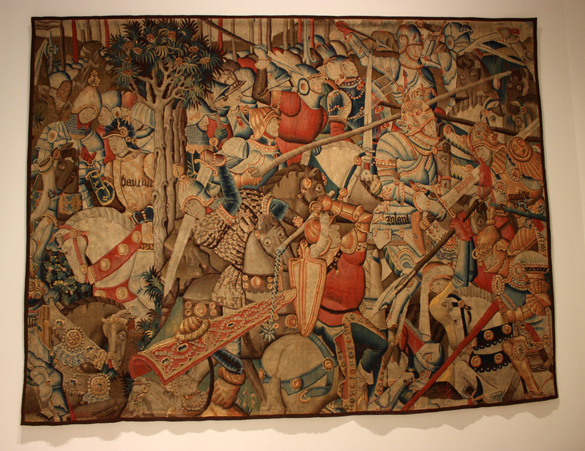
15th Century Tapestry Depicting The Battle of Roncevaux

Which is why I'm going to suggest something: a militia. An international group of militias attached to dioceses and other religious shrines with one purpose: to protect the holy places of the Church from vandalism. A fraternal organization like the Knights of Columbus who exist to assist the Church and protect it from the acts of vandalism and desecration so prominent in our modern world. Think of it as a Security Company of sorts, like large corporations use, except it doesn't exactly work for profit. It raises money via donations and other programs.


Is it extreme? Yes. Will it be unpopular? I imagine so, unless I am a poor judge of the character of modern man. But we have to do something, and the IMBC seems like a good start. It will get us working together and out of the page to do a bit more for our local parishes. It's going to be a rough climb to get started, undoubtedly. Those interested should seek to contact me personally via the Blog or the Facebook page. We'll have to start small, and unofficial. But as time goes by and if this picks up traction, we can get ourselves out there finally and do something positive for our local parishes.

How do we start? My first suggestion is to be vigilant in your own parish in your prayer life. Second - as I've already said - if you're interested in helping to formulate this or get started, all advice is welcome. I'm not exactly an expert with things like this, and I'm going to need men who are if this is going to work. I know most of us around here aren't very vocal on most blog or page posts, but if you never are again I need you to be now. I need to know what you all think, and if you know a way for us to get started.

War flag of the Holy Roman Empire (1200-1350)
Uniforms, a badge, colors, and other such ideas are forth coming. I know some talented artists who would be willing to draw some stuff out just to get the mind going. In the end, I mean for this to function as a fraternal militia that will stretch everywhere the Catholic Church is. It will protect her monasteries, her shrines, her clergy, her churches, and her laity from assault and harm from all threats - foreign and domestic. They will be pious, militant men in good standing with the Church. They will keep watch of the holy places and spend their watches in prayer. They will be a wall to the faithful, and a flail to the malcontents.

For too long, Catholicism has been unjustly scornful of its past. These men must serve as a reminder of the power and glory of the Faith, given and sanctified by the grace and goodness of our Blessed Lord.

"Take this holy sword, a gift from God, in whom thou shalt overthrow the adversary of my people Israel."

Saturday, December 21, 2013

Caesar Alloquitur: Germany

Remember when Germania was this awesome? The Kaiser remembers.
Germany was once the heartland of the Holy Roman Empire, the successor-state of the Carolingian Empire that laid the foundation for what would become Christendom.

I posted an article on the Facebook page recently. After going through and reading it thoroughly, the closing remarks are what interested me most.

The bishops have repeatedly complained of the loss of membership and blame the Church’s refusal to change teachings such as that on divorce, the reservation of priestly ordination to men and clerical celibacy. The German media, however, has pointed to the clerical sex abuse scandals as a major motivator for the refusal of Catholics to continue paying the tax levy. In 2011, 126,488 Catholics asked to be removed from registers.
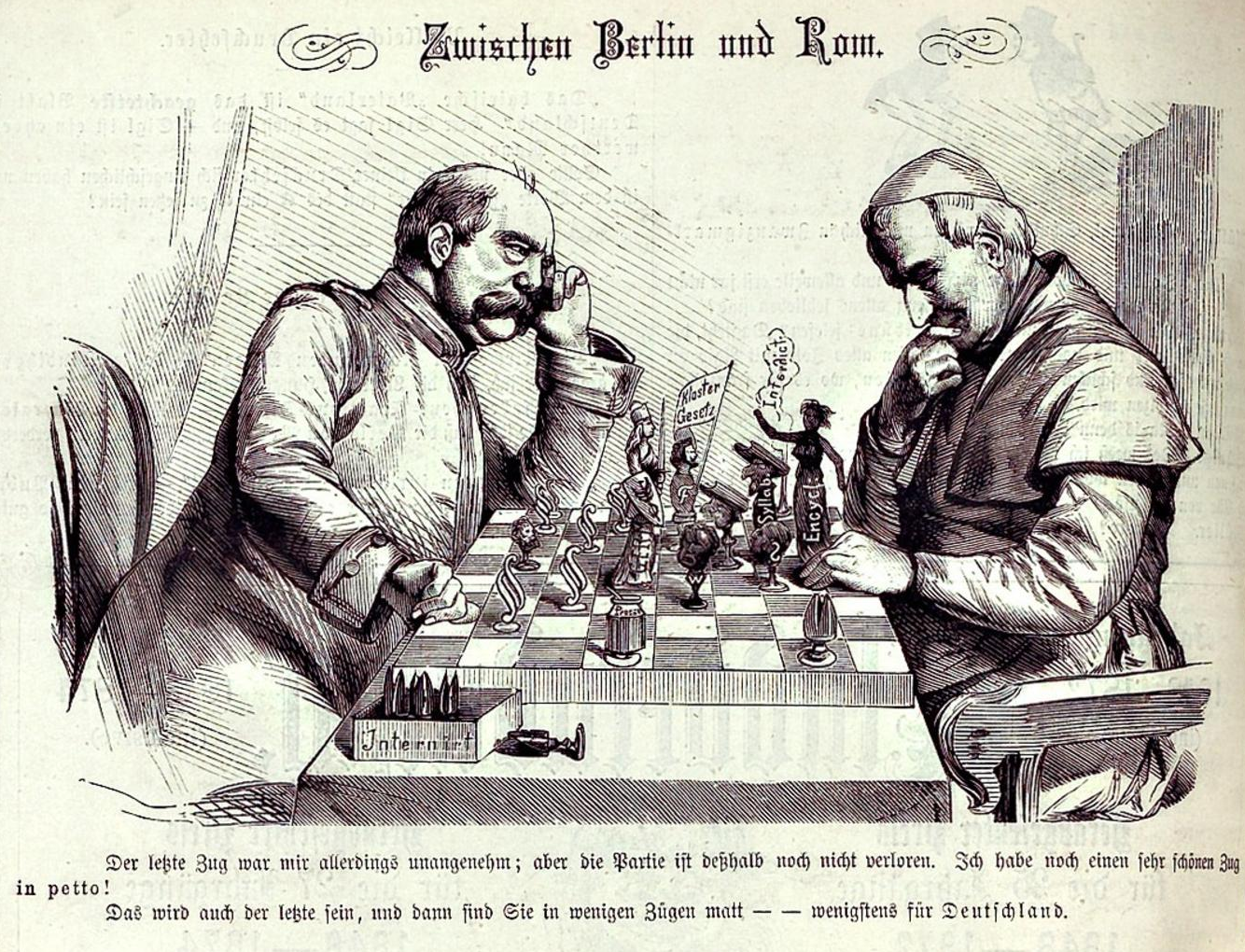
What is this tax levy they're talking about, you ask? Well, the German Church has a rather efficient way of obtaining tithes from members. On their tax forms, German citizens identify with a certain church. They pay a tax of sorts that goes to that church. It's a rather effective system, if you ask me. How on earth the Catholic Church got that kind of voice after the Kulturkampf of Bismarck which effectively De-Catholicized the country, I don't know, aside from a miracle of God.

"Between Berlin and Rome", with Bismarck on the left and the Pope on the right Kladderadatsch, 1875
In any case, this highlights something very interesting for me. I'm a very, "read between the lines" sort of individual. I don't take things at face value, and I don't automatically assume that any action is completely isolated from affecting things other than what it was originally aimed at. For example, one can note simply from meditation and observation the temporal benefits of a society which abides by the teaching of the Church, even if some of those temporal benefits were not expressly spoken of when the teaching was proclaimed.

In other words, Cardinal Walter Kaspar - a very big proponent of this change - isn't suggesting we re-instate divorced and re-married Catholics into the Church and allow them to participate in the Sacraments simply because he's all magnanimous and an enemy of those meany-head Authentic Catholics and all their rules. He's concerned about his bottom line.
Doubtless, every church needs to function, and it's a big problem if they don't have the funds to keep churches open. But this isn't the way to solve the problem. Are we so quick to forget the story of how Christ always provided for the Apostles? He obtained them money to pay taxes, food to feed themselves, even when any pencil-pushing accountant would've said their books were all out of whack and they needed to seriously re-asses themselves. But the Apostles kept the faith, and as long as they did when they were with Christ, everything was taken care of. It was hardly glamorous, but hey, they lived. They saved souls. That's about all that matters, right?

The Apostles could make one sermon and with that one sermon three thousand converts. We can preach three thousand sermons and not make a single convert. Why do you suppose that is? I think it's got something to do with how we go about it. I saw a video recently of a poet speaking one of his poems at a poetry club. In essence, the whole point of it was that we as a society have lost our eloquence and conviction when we speak. We don't say anything with certainty; we avoid declarative statements. I think that's a problem a lot of Church men have; they are afraid of being labeled this or that or the other. The Apostles didn't fear that. The Prophets didn't fear that. Christ didn't fear that. I will beg the Churchmen of today to stop dishonoring your fore-bearers. Stand for truth. I'm sure there are millions around the world who would donate to the German Church, if it's struggling that much to make ends meet to where you'd be willing to do your job poorly in order to get it.

I beseech the Imperials to say a prayer for the German Church, that it might return to tradition and strive to be authentic in its Catholic Faith. I know at times for men like us we're used to being told, "Shut up and go pray about it, why don't you?" It riles the blood, because we want to do more than pray. I too struggle sometimes with the very action of prayer, as my soul and heart is imbued with the desire to do more than be on my knees. But as soldiers in the foxholes eager to shoot back at the enemy, we must wait for the word from On High before we let them have it. Say your rosaries, go to Mass, pray for the Church. Donate to your local parish, and keep the Faith alive.


Be sure to like and share our Facebook page. Don't forget our new Facebook Group as well! Post and comment and discuss with your fellow Imperials!

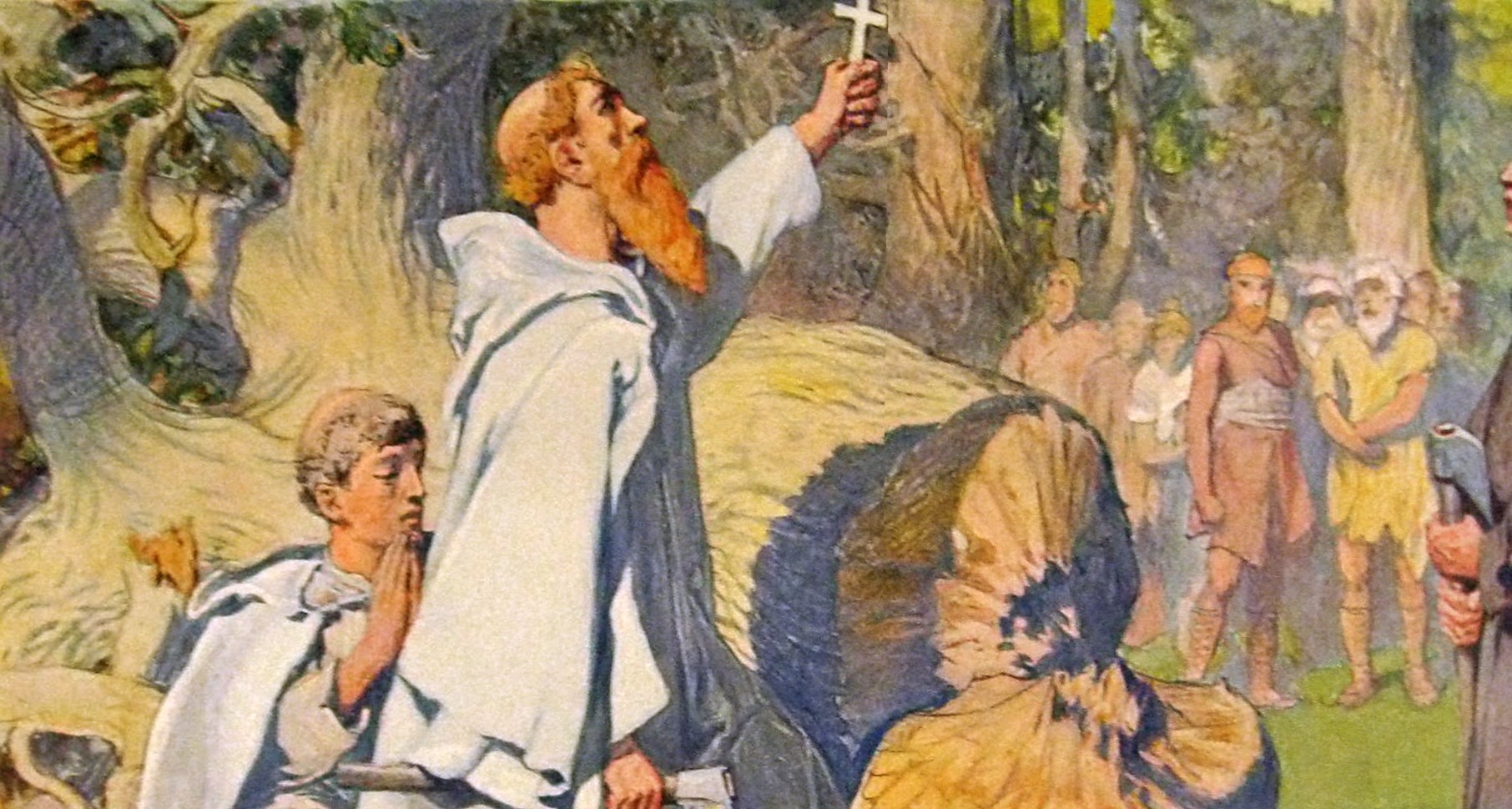
Methniks Germania is in need of a Saint Boniface right now. It might be a wise idea to say a prayer to him for Germany.

Tuesday, December 17, 2013

Iudicium Caesaris: Philip IV of Spain


Not to be confused with this douche-canoe. Don't worry, Philip, I'll get to you someday; you'll wish I hadn't.
That's better.

Philip IV was one of those monarchs who's reign was neither an abysmal failure or a complete success. At the time he did a lot of good things, but unfortunately outside influences and the propaganda engines of his enemies did more to influence perception of him for the next few centuries after his death rather than honest critique.

Philip IV was an enthusiastic patron of the arts and theater (his affairs with actresses aside); a well-learned man with a particularly strong attraction to astronomy. In fact he regularly frequented parlors and salons with several other nobility to discuss contemporary literature of the day. If the accounts are to be believed, their commentary was rather satirical. A precursor to modern-day internet critics?

He was a good father by the standards of his day, and very pious in spite of his personal faults when it came to sexual morality. His policies reflect his conservative beliefs: he saw Europe as destined to be ruled by family-based Hapsburg hegemony in the fashion of his ancestors. He passed laws closing down the legal brothels in Spain, taxed luxury items heavily, and worked closely with the papacy to keep Spain's proud record of having the most upright and orthodox clergy in Europe, something that was in jeopardy due to a few decades of neglect.

Perhaps where he most desperately needed to shine was in the Thirty Years' War, a conflict that would have long-lasting ramifications for Catholic Europe, and not good ones. The Spanish Military performed well, but quickly modifying strategies and economic issues ultimately brought Spain to the short end of the stick. Philip was not a warrior at heart, and wanted peace more than anything. Arguably Spain could've benefited much more from a warrior-king, and those arguments would be right, but things have unfolded as they should, and by the grace of God the NSIR will right the terrible wrongs done by the Thirty Years' War to Europe regardless.

Not a perfect man, but a good man. Not a perfect monarch, but a good one, or in the least far better than what they could've gotten. He implemented a lot of good policies and had great ideas, but unfortunately outside forces often stopped these plans from being realized.

For more general information on Philip IV of Spain, check here. I know Wikipedia isn't the most reliable source, but it's a good starting point and sometimes even the reference section for articles serves as a nice little reading list for the more dedicated student of history.

Be sure to check the official facebook page of the NSIR. Like and follow and share our content and blogs and let us know if there's anything else you'd like to hear the Kaiser's opinion on!